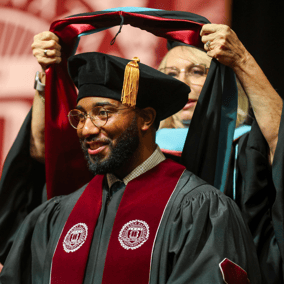

Doctor of Education in Administration and Leadership (Ed.D.)
Follow us on socials to connect and get up to date information on upcoming events and more!


"The master's and doctorate programs at SNU have provided the necessary educational experience and knowledge to successfully advance my career. They have also given me the opportunity to build relationships with high-quality leaders in the faculty and classmates, and that has forever changed my life for the better."
Jonathan M.
Ed.D.Graduate
.png)

Ed.D. Program Overview
SNU’s Doctorate of Education in Administration and Leadership (DEAL) program stands out as the premier program for those who want to achieve a terminal degree! One characteristic that makes our doctoral program unique is the capstone component. Instead of a dissertation, doctoral students now produce a journal submission based on original research, equipping them with valuable assets for their careers and professional communities.
Another characteristic that impacts students is the support that is provided. Each student has a research professor that will advise and coach them through the research writing process. Our commitment to providing a research professor is a difference maker and is reflected in our high graduation rate. The DEAL program is an excellent choice for you as you consider earning a top degree in your field that will help you accomplish your personal and professional goals.


6
week course format

2
Start dates per year

32
Graduate in as few as months

57
total credit hours

$799
Per credit hour

100%
Learn one night a week on campus or online
Frequently Asked Questions
Earning a degree while working full-time or raising a family is possible at SNU because:
- Classes take place online or one evening a week, allowing busy adults to earn a doctorate without sacrificing the things that matter most
- Focus on one course at a time before moving on to the next to ensure true mastery
- A research professor is paired with you from the beginning of the program to ensure your success as a student and researcher
- Instructors with vast amounts of industry experience guide students through courses.
- Textbooks can be delivered directly to your door at the beginning of each class with a textbook subscription service.
With a Doctorate of Education in Administration and Leadership from SNU, you can pursue a variety of leadership roles in educational institutions and beyond. Graduates are prepared for positions such as school district superintendent, principal, or higher education administrator. Additionally, you can work in nonprofit or government sectors as educational consultants, policy advisors, or training and development leaders. The program equips you with advanced skills in strategic planning, organizational leadership, and educational policy implementation, enabling you to lead impactful changes in educational environments.
You should pursue a Doctorate of Education in Administration and Leadership to enhance your ability to lead and manage educational institutions effectively. The program provides advanced skills in strategic decision-making, organizational leadership, and educational policy development. With a focus on ethical leadership and real-world application, SNU’s program prepares you to tackle complex challenges in educational settings, fostering positive change. Additionally, the program’s flexibility supports working professionals seeking to balance their studies with their current career.
Graduates with a Doctorate of Education in Administration and Leadership can be hired by:
- K-12 School Districts for roles such as superintendents, principals, and district administrators.
- Higher Education Institutions for positions like university deans, department chairs, or provosts.
- Nonprofit Organizations in leadership and educational policy development roles.
- Government Agencies involved in educational policy and reform.
- Corporate Training and Development departments focusing on leadership training and organizational improvement.
A Doctorate of Education in Administration and Leadership prepares you for roles such as:
- School Superintendent
- University Dean or Department Chair
- Educational Consultant
- Chief Academic Officer
- Instructional Coach
- Higher Education Administrator
- Policy Advisor in Government or Nonprofit Organizations
- Corporate Leadership Trainer
- Strategist
These roles focus on strategic leadership, organizational development, and advancing educational initiatives in various settings.
Graduates with a Doctorate of Education in Administration and Leadership can expect average salaries ranging from $90,000 to $150,000 annually, depending on the specific role and location. For example, school superintendents may earn on the higher end of this scale, while higher education administrators such as deans and provosts often fall within a similar range. Other positions like educational consultants and policy advisors can also offer competitive salaries, reflecting their leadership and strategic expertise in educational settings.
SNU's doctoral program is unique because of the consistent and incredible support that the research professors provide as they guide students through the entire 32-month process. The feedback and support each student receives is clear and helpful. Research Professors are always available and teach the research courses as they support students' work on their individual research projects.
In the DEAL program, you can expect 10 - 20 hours of work per week. It's a big degree and requires a commitment of time and effort from each student who wants to success and make it to graduation. Students have great support for their learning and are expected to read and write at a high level as they respond to the guidance of their research professors.
The entire DEAL program costs $44,403 ($779/credit hour). Most students use financial aid through FAFSA. Some students self-pay, and others do a combination of both. Books are extra, and the Graduate Studies in Leadership program is launching a trial run with a book broker—similar to Spotify only with academic books—and all books would be available for $149 per term.
SNU has an active network of over 600 educators across Oklahoma, Texas, and the United States! Networking opportunities exist online, and while job placement is not currently offered, there are multiple opportunities for in-person networking at SNU career fairs, the annual Women in Leadership Symposium, and SNU's monthly Business and Leadership Network.
You should pursue your Doctorate of Education in Administration and Leadership at Southern Nazarene University because SNU emphasizes servant leadership, preparing you to handle complex educational challenges through a faith-based approach. The program offers flexibility for working professionals, allowing you to balance your career while gaining advanced skills in strategic planning and organizational leadership. With a focus on real-world applications and small class sizes, SNU fosters personalized learning and provides opportunities to lead transformative change in educational settings.
"SNU is set apart by various components of the program including the spiritual focus, a cohort model, six week class schedule, and embedded dissertation. I would also mention the program supports students through consistent guidance and feedback."
Susan W.
DEAL Graduate
Courses
Engage in meaningful coursework that will propel you toward graduation with your doctoral degree. Upon finishing this degree program, you will be prepared to affect meaningful change as a leader wherever you go.
Credit hours: 3
This course will focus on Biblical and worldview perspectives in the area of leading shareholders, citizens, and the workplace of the student and in companionship with the SNU mission. The practices, standards, and styles of leadership will be introduced and examined with a variety of teaching methods and experiences. Understanding the critical intersection of leadership and servanthood will help frame each student’s philosophy as a visionary leader.
Credit hours: 3
Foundations of Research will introduce learners to the structure and format of a dissertation and will focus on the foundational components of a dissertation to include topic selection, problem statement, theory/theoretical framework, purpose statement, research questions/hypotheses, qualitative and quantitative approaches, and research design. Learners will also continue building a collection of research through critiquing, analyzing, and synthesizing peer-reviewed literature relevant to their research interest area. Learners will work collaboratively to create a dissertation problem statement that is well-supported and grounded in the existing literature.
Credit hour: 3
In today’s highly competitive and dynamic organizational environment, it is essential for leaders of all disciplines to be able to effectively deal with the wide range of organizational challenges with which they are presented. The ability to respond to the need for change is one of the hallmarks of contemporary organizations and students will examine the full spectrum of organization development tools and methods that can be implemented to increase organizational effectiveness. This course examines the major components of organizational development including the history of organization development and education reform initiatives, theories and process models, organizational culture, action research, and leading change initiatives.
Credit hours: 3
The Literature Review course will develop strong research, critical thinking, and writing skills to better equip students in their completion of the literature review section of their dissertation. The course focuses on understanding the purpose of the literature review and the fundamental skills needed to complete it such as developing search strategies, synthesizing sources, and constructing paragraphs. Learners will be required to apply writing, research, and critical thinking skills in writing components of the literature review and will also have a working draft of the Literature Review of their dissertation when the course is complete.
Credit hours: 3
This course will develop an intercultural understanding for the effective leader, by examining the different cultural aspects and diverse influences on leadership and ethics. This course will examine the interaction of internal/external diverse intersections of identities and cultures on the leader and explores the ways in which a leader’s identity and cultural experiences and values inform ethical decision-making and how different ethical and cultural systems address and define moral issues that arise in organizations. Ethical issues and practices will be analyzed as they relate to the decisions and styles of the leader and the growth of a leader is becoming culturally responsive
Credit hours: 3
This course explores advanced research strategies and the development of designs and methods supporting research in leadership. Exposure to rich research traditions in the field of leadership and both knowledge and skills to begin doctoral research will be introduced. Students will achieve the skills necessary to search for, retrieve, and analyze information and data from a variety of sources. Students will also begin the development of the scholarly writing needed to successfully complete their dissertation research.
Credit hours: 3
This course will present the relationship of theory and implementation to leadership practices. Based on research, students will develop vision and mission statements that relate to the structure and functions of organizations. Learners will complete a project developing mission and vision statements for an approved organization, including the collaboration of stakeholders and documentation and reflection of the process.
Credit hours: 3
This course explores and analyzes the traditions, philosophies, and techniques of qualitative research. Students will experience participant observation, interviewing, and document analysis. Students will practice qualitative techniques and engage in initial data analysis related to their dissertation research.
Credit hours: 3
This course introduces students to quantitative methodology. Students will learn about descriptive and inferential statistics through exposure to parametric and non-parametric design models. Learners will obtain the skills to utilize their newly acquired methodology knowledge to critically analyze existing quantitative research.
Credit hours: 3
Concentrating on the understanding and development of one’s self and others, this course will build on the interpersonal and collaborative leadership skills previously accomplished by participants. It will facilitate the discovery of a diverse range of human practices as they relate to personal and organizational relationships in a variety of areas including constructing a team’s collective goals, creating role definitions within a team, managing conflict, team collaboration, and productive professional relationships. Learners will analyze these relationships through research and philosophical positions and will examine connections in historical and contemporary contexts. Students will be exposed to knowledge of empowering leaders to create productive and effective decision-making skills in the workforce.
Credit hours: 3
This course will present the critical importance of strategic planning for the purpose of implementing the goals of the organization. Strategic planning models will be introduced and discussed. Practical skills will be presented for building short and long term strategies based on current theories in strategic planning as well as best practices in multiple environments. The students will develop skills and knowledge on how to prepare the workplace for phases of implementing strategies for effective and progressive change.
Credit hours: 3
This course will develop an understanding of how to inspire, motivate, and rally around a shared and corporate vision. Students will explore innovative strategies and the implementation of those concepts with other colleagues in the workplace. An emphasis will be placed on creating purposeful goals for the organization and visionary sustainability.
Credit hours: 3
The focus of this course is multi-faceted. Learners will analyze, critique, discuss, and develop learner-centered, curriculum-based instruction that utilizes technology in authentic and meaningful ways for those in leadership roles. Students will complete in-depth investigations of specific learning tools and present their findings concerning the uses of the tool. Scholars will explore the latest research into how technology can most effectively facilitate their leadership. Learners will also investigate technology-related issues such as integration models, safety and health, copyright, evaluation of web resources, assessment, and assistive technologies.
Credit hours: 3
This course will provide an analysis of State and Federal regulations, guidelines and court decisions related to education, business, and public service organizations. Students will examine the impact of these processes and policies and project trends and applications for governance and policy-making based on theory and observation.
Credit hours: 3More than ever
in the past, the ability to lead effectively, respectfully, and sensitively across cultures has become crucial. This course offers its learners opportunities to examine global systems and traditions along with comparing and contrasting cross-cultural communications, famous international leaders’ models, and proven global leadership methods. Additionally, the learners in this course will develop and assess innovative and effective leadership approaches that foster global awareness and education.
Credit hours: 12
Doctoral students will be enrolled in research writing credits each term. These will be determined by program mapping courses starting with the first term of the program. The research writing is embedded within each term. Students must maintain a minimum of 2 research writing hours each term until their research writing is successfully produced into two publishable articles. The Research Writing Proposal Meeting will occur between Term One and Term Two. The result will be a program of study agreed upon by both the learner and the learner’s Research Committee members.
Meet our SNU Faculty

Dr. Stephoni Case
Program Director
Dr. Stephoni Case began her career in Education as a high school English teacher - and realized very quickly that believing in students and helping them accomplish their goals was her calling. Dr.Case began her journey in higher education and taught in the Communication Arts Department at SNU for 19 years before she transitioned to Oklahoma State University in Stillwater as the Director of the Center for School Business Management. In 2014 she returned to SNU as the Director of the Master of Arts in Education Leadership (MAEL) program and in 2019 launched and now leads the Doctor of Education in Administration and Leadership – known as the DEAL program.
“Working with graduate students who have made a commitment to reach their goals is a great blessing! I am always grateful for the hope and the determination I observe in these students who are making a positive difference in their professional communities."

Dr. Shawn Pendley
Education and Leadership
Shawn Pendley graduated from The University of Oklahoma in 2015 with a PhD in the History of Education (Intellectual History). His previous professional experience includes academic manuscript editor, high school English teacher, summer college instructor for Upward Bound/TRIO at Oklahoma City Community College, and Assistant Professor of English Literature and Chair of Humanities and Sciences at Southwestern Christian University. He has served as the Academic Chair of the Oklahoma Educational Studies Association, Session Chair for the AERA 2017 Annual Meeting, and has served in a number of ways for the Society of Philosophers and Historians of Education (SOPHE). He was a major contributor to The Encyclopedia of the Social and Cultural Foundations of Education (2008) and edited Susan Laird’s seminal intellectual biography of Mary Wollstonecraft titled, Mary Wollstonecraft: Philosophical Mother of Coeducation (2008). He serves as the Chair of SNU’s Institutional Review Board and is currently a member of the Historical Society of the Episcopal Church.
In addition to designing program modules, he regularly teaches foundational research courses here at SNU for the DEAL program. His passion is helping doctoral students conceptualize their research, and he views his work as a form of mentorship. The purpose of the DEAL program is to build a community of scholar-leaders, and communities are built up from personal relationships.
Dr. Pendley’s research interests include education in classical antiquity, first century epistolary pedagogy, supporting and retaining doctoral students, and late acquisition of critical reading and writing skills among adult learners.

Dr. Kent Shellenberger
Education and Leadership
Kent Shellenberger, Ed.D, is a career educator with 45 years of professional experiences in common and higher education. He currently serves as an instructor in the traditional and graduate SNU programs. Dr. Shellenberger’s professional involvement includes: active state involvement as the elected member of the American Association of School Administrators’ governing board and Oklahoma Federal Relations Representative; member of the State Superintendent Advisory Council; Legislative Liaison for United Suburban Schools Association; Cooperative Council of School Administrators (CCOSA) Innovative Leadership Academy and a governor appointed board member of the Oklahoma Educational Quality and Accountability Commission (OEQA) and the Specials Needs’ Task Force Legislative Committee.
Dr. Shellenberger’s dissertation was “PRINCIPALS’ AND TEACHERS’ PERCEPTIONS OF LEADER SUCCESSION IN SELECTED PUBLIC SCHOOLS.” He has been a presenter at the First Year Superintendent’s Academy and breakout facilitator of OSSBA/CCOSA annual convention. He also authored quarterly articles for Better Schools while president of CCOSA, OASA and Federal Relations Representative. Dr. Shellenberger was recognized as Oklahoma State Superintendent of the Year and is a member of the Oklahoma Educator’s Hall of Fame.

Dr. Rachel Kim
Education and Leadership
Younglong “Rachel” Kim earned her Ph.D. in Educational Leadership and Policy Studies from Oklahoma State University, where she served educational leaders, preservice and in-service educators, and diverse student populations, including community members, through research, teaching, service, and leadership for eight years.
She is committed to helping doctoral students bridge scholarship and professional practice through rigorous and meaningful scholarly engagement. Her approach emphasizes reflective inquiry, evidence-based practice, and professional development grounded in purpose and vision.
Her research interests include professional development, psychological needs support, educational technology, and practitioner-scholar development. She seeks to understand how thoughtfully designed professional learning environments foster motivation, growth, and meaningful integration of research and practice at both individual and organizational levels.
Guided by Colossians 3:23 from the Epistle to the Colossians — “Whatever you do, work at it with all your heart, as working for the Lord” — she views her work in higher education as both a calling and a joyful responsibility.
She is an active member of the American Educational Research Association (AERA), the University Council for Educational Administration (UCEA), and the Korean-American Educational Researchers Association (KAERA).

Dr. Shari Rodgers
Education and Leadership
Dr. Rodgers is an SNU alum and holds a Doctor of Education in Administration and Leadership, a Master of Arts in Educational Leadership, and a Master of Arts in Administration of Special Education. Certified in Oklahoma as a superintendent, principal (elementary and secondary), and K-12 mild/moderate special education teacher, her scholarship and presentations focus on integrating culturally responsive practices, ethical leadership, and faith-based perspectives in education. Dr. Rodgers' research and volunteer work with the Oklahoma Legislative Diabetes Caucus have contributed to school-based diabetes management legislative initiatives.
Dr. Rodgers currently serves as an Assistant Professor and Dissertation Director/Research Advisor, teaching courses in educational leadership, research, organizational leadership, and culturally responsive ethical leadership. With more than two decades of experience in K-12 education, Dr. Rodgers has led secondary English courses, supported students in alternative education programs, and served as Federal Programs External Evaluator for Oklahoma City Public Schools. As a consultant, she has provided expertise to multiple Oklahoma school districts in areas such as federal programs support and program evaluation, student information system support, and culturally responsive leadership.
Dr. Rodgers and her husband, Tarrence, live in Midwest City, have five adult children, and five grandchildren. In addition to being OKC Thunder fans, she and Tarrence have been active members of People's Church for approximately 17 years. Dr. Rodgers enjoys gardening in flower beds and feeding the families of birds around her home. At the heart of her work, Dr. Rodgers seeks to model the image of God to others in the communities she supports, and empower future educational leaders to foster equity in education, cultivate thriving learning environments for students, prepare educators and others to work with students living in vulnerable situations, and to continue research
Admission Steps
Enrolling at SNU is a simple process. With rolling start dates, there’s no need to wait months at a time to begin your educational journey. Once you have earned your master’s degree or 33 graduate hours in an equivalent program from an accredited university with a GPA of 3.25, take the following steps.
Step 1. Ensure you meet program requirements as follows.
- Completion of a master’s degree or 33 graduate credit hours in an equivalent program from an accredited university.
- GPA of 3.25 from prior graduate coursework
- For non-native English speakers, either an overall band score of 7.0 or higher on the IELTS or minimum sub-scores for each element of the TOEFL iBT are:
Speaking: 22
Reading: 20
Listening: 15
Writing: 20
Step 2. Completed Graduate Application
Step 3. Send official transcripts from graduate degree conferred to SNU at pgsadmissions@snu.edu or ATTN: PGS Admissions, Southern Nazarene University, 6729 NW 39th Expressway, Bethany, OK 73008.
Step 4. Submit the following application materials to pgsadmissions@snu.edu
- Two Recommendation Forms
- Research Topic and Plans
- Curriculum Vitae or Resume
- One Writing Sample demonstrating satisfactory writing ability by submitting one of the following:
- a single-authored writing sample from previous coursework
- a two page APA aligned paper on an academic topic
Step 5. Following the submission of all required application materials, you will be invited to interview with a Research Professor as the final step in determining acceptance.
APPLY
Locations

Online
Online classes are specially
designed for professional &
graduate studies.
Phone: +1 (405) 491-6332
pgs@snu.edu




-1.png?width=276&height=276&name=Blog%20Photos%20(51)-1.png)